A restaurant robot may carry meals to a table, move dishes through a kitchen, or answer a guest’s request at a kiosk. These machines are taking on narrow jobs, which gives owners a clearer way to judge where automation helps and where people still need to lead.
- Delivery robots carry food across dining rooms
- Kitchen systems move ingredients or repeat set motions
- The main test is service quality, not novelty
Where robots fit in a restaurant
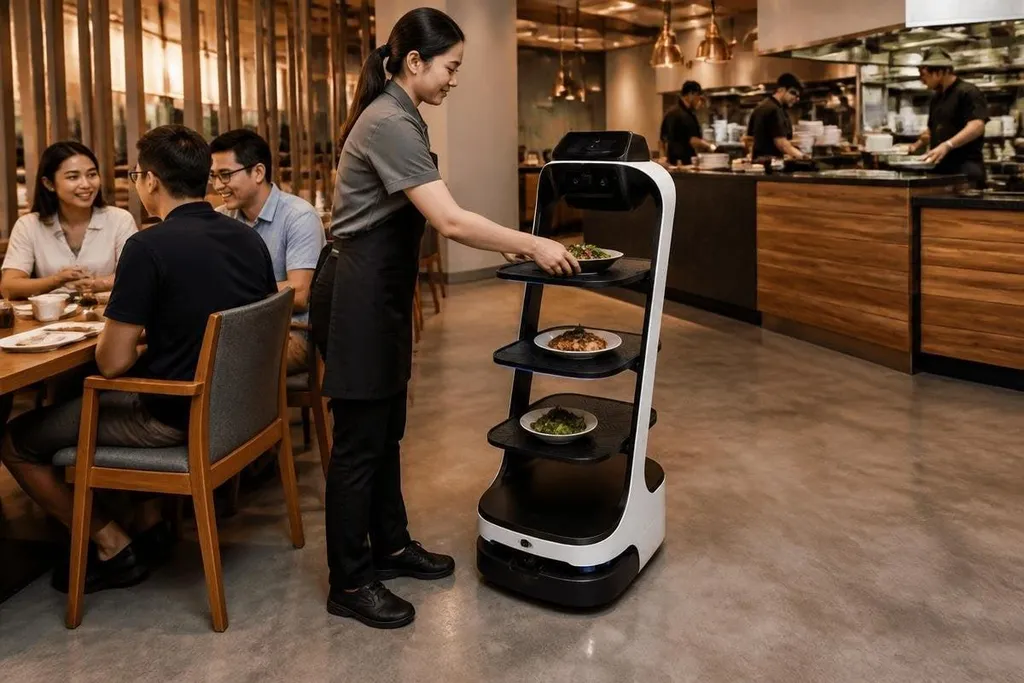
Dining rooms are a practical starting point because the work repeats. Once loaded, the mobile robot can receive a tray, follow a mapped route, stop near a table, and return to a charging point. Staff still load the food, greet the guest, and handle the handoff.
That division changes the job rather than removing every human step. A server may spend less time walking plates across the room and more time checking orders, answering questions, or clearing a table. The result depends on the restaurant’s layout and menu, so one machine won’t fit every site.
Kitchens offer a different set of tasks. In a kitchen, a robot arm can repeat a fixed movement, such as placing items into a fryer basket or moving a container between work areas. These tasks suit automation because the robot works from set positions and follows the same sequence each time.
The limits show up when the work changes. A crowded kitchen, a wet floor, an unusual container, or a missing ingredient can force a person to step in. Food preparation also brings safety rules that affect where a robot can move and who may work beside it.
What changes for staff and guests
The machine can reduce walking and repeated lifting, but it adds setup work. Someone must load trays, clean contact surfaces, check sensors, clear routes, and respond when a wheel or arm stops. Those duties need time during every shift.
Guests may accept a delivery robot when its path is clear and its handoff is easy. A blocked aisle creates a different experience. The machine needs enough room to turn, and staff need a clear way to reach the order without making the guest wait beside it.
That practical test gives restaurant robotics coverage from Robot24.com a useful job. Reports can help you compare a machine’s claimed task with its work during a full service, including staff interventions and blocked routes. Those details lead to the repeatable jobs that make restaurant automation worth pricing.
The strongest use cases tend to have a plain shape. The task happens many times, follows a repeatable path, and causes a real delay or strain for staff. If the task changes every few minutes, people may still handle it better.
The costs that do not appear on the menu
The purchase price is only one part of the decision. A restaurant also needs floor space, power, software setup, staff training, cleaning time, repairs, and a plan for service interruptions.
If the robot needs a person nearby for every trip, the labor saving may be smaller than expected.
Data raises another question. Cameras, LiDAR, or other sensors may map the robot’s route and help it avoid objects. Owners should ask what data the system stores, where it goes, and how long the supplier keeps it.
Food safety needs a written process. The restaurant should set rules for cleaning, tray contact, spills, blocked paths, and manual recovery. One that works well in a quiet dining room may need a different process during a busy service.
I'd skip a robot bought mainly for its video appeal. The better reason is a task with a clear cost, a repeatable method, and a safe way to recover when the machine stops.
A practical buying check
Use this list before asking for a trial:
- Map the task. Record how often it happens, who does it, and how long it takes.
- Measure the space. Check door widths, aisle clearance, turning room, lifts, and charging access.
- Test the handoff. Watch staff load, unload, clean, and recover the robot during a busy period.
- Ask about service. Get response times, spare-part costs, software fees, and warranty limits in writing.
- Set a result. Choose a measure such as fewer walking trips, shorter waits, or fewer lifting tasks.
A short trial should use normal staff, real orders, and the busiest part of a shift. That test will show whether the robot removes work or moves the work somewhere else.
Restaurant automation will keep growing through narrow jobs first. The next useful question for an owner is specific: which repeated task costs the most time today, and can a robot handle it without making service harder?